This blog is to celebrate the paper dolls I had as a child growing up in the late 1940s - early 1950s.....and others I would have also loved!


Monday, August 11, 2025

Velva Doll - The Magic Playmate


Velva Doll was produced in 1932 by Kingston Products Corporation. Information above is from Mary Young's  20th Century Paper Dolls. Two sized Velva dolls were produced....one large 17" doll and a smaller 13" doll, both named Jill. Mary Young indicated another version of the Velva doll has been found, so dolls may vary. 

My Jill doll is 13" tall and came with many items of clothing. 


 Jill is made of 1/8" cardboard with a velvety surface. Her neck has been repaired and her coloring has faded, but you can still see her red hair and pale blue eyes. 

These are the clothes made of felt that came with Jill.


In addition to dresses, jackets and slacks,  several collars and yokes, plus suspenders, hats, gloves and a neck scarf were included for play. 


Playing with accessories..... 


Instructions came with Velva dolls....


and also suggestions for creating different outfits.


Checking this sheet, I think Velva arrived with her complete wardrobe!


A more detailed set of clothing came with Velva, and I was curious what doll they belonged to. 


Looking through Mary Young's wonderful book on paper dolls, I found several sets of "magic" paper dolls....


                   The Magic Doll for the Little Dressmaker, $40.00

and discovered that the extra clothes were part of The Felt-O-Gram Doll and Her Wardrobe. This set was made by The Poster Products Company of Chicago in 1932. The the black and yellow dress on the front of the box and the little red dress, boots and cap in the lower left corner of the box are the same clothes that came with Velva. Between 1932-1934, the Poster Products Company made several other sets of Felt-O-Gram dolls....Twins, All American Boy Bobby, Black-Eyed Sue and I'm  BebĂ©  of All Nations.


Just for fun, I dressed Jill in the extra set of clothing even though they were a bit large for her......


I am always happy to learn more about the paper dolls I have collected. And thanks to Mary Young for her exceptional book 20th Century Paper Dolls!


Thursday, June 26, 2025

Poky-Hontas, a paper doll with "real" hair!


This is Poky-Hontas, a paper doll with "real" hair, produced by The DeJournette Mfg. Company, most likely in the 1950s. 

Paper Doll House Co. was formed in Atlanta, Georgia in the late 1930s. When it incorporated in 1946, it was renamed after its paper doll designer, Alma DeJournette. 
In the 1950s, their paper dolls had many added features that were not like other paper dolls sold at that time. 

Examples listed in Mary Young's 20th Century Paper Dolls Identification & Values....

★ Dolls might come in a box that converted to a trunk or a house
Dolls might have paper clothes that were washable
★ Dolls might have eyes that blinked
If a baby doll, it might come with a cloth diaper, bottle and actually drink water
★ Dolls might have "real" hair

Poky-Hontas came with six colorful decorated dresses and a jacket, plus some small accessories that are missing from my set


What a nice wardrobe to dress little Poky-Hontas!

This special paper doll can still be found new in the  package on Ebay.

OK, now you are wondering about the information above telling you  "If a baby doll, it might come with a cloth diaper, bottle and actually drink water"....I did also!  Mary Young answered that question by adding a picture of the paper doll box, 

LITTLEST DARLING   
The Paper Doll That Drinks and Wets.


Wednesday, May 14, 2025

Pepe and Pepita from Mexico


 This is PEPE and his twin sister, PEPITA. They live in Mexico, and are going to show you different kinds of clothes worn there. 


Pepe's shirt and trousers are white cotton, and he wears a bright sash or 'faja' to keep them together. The gay blanket is a wool 'sarape'. It has a hole in the middle for Pepe to put his head through. When he isn't wearing it like that, he carries it folded over one shoulder, and when he isn't wearing it that way he is probably wrapped up in it fast asleep. His sandals are woven of leather thongs.

Pepita embroidered the flowers and birds on her blouse  herself. She never leaves the house without her shawl, called a 'rebozo'. The basket and doll are both made of straw. If the pig bank looks wise it is because he has a secret - he is guarding all Pepe and Pepita's pennies.


These are the costumes worn in Tehuantepec, which is the tropical country in the south of Mexico. There is an interesting story about Pepita's headdress. When the Spaniards first came to Mexico they gave an Indian woman a baby dress with lace frills on the skirt. She didn't know what it was for, so she just put it on her head and folded the lace frills back the way you see it now. All the other women copied her headdress, and it has been worn in that region ever since. Pepe tries to scare all the other little children with his fierce looking mask.


When there is a big fiesta or holiday, Pepe and Pepita dance the 'Jarabe Tapatio' in these costumes. Pepita wears a rebozo again, but in a different way, so that it will not slip off as she dances. Pepita's skirt is bright red flannel and is so heavily embroidered with sequins and spangles that she has to hold it up when she dances around Pepe's big sombrero.


Now Pepita pretends she is a Spanish senorita, and hides her eyes behind her fan. She puts a high comb and flowers in her black hair. Pepe puts out his chest and says he is a brave 'matador' - but if he is a bullfighter, where is the bull?


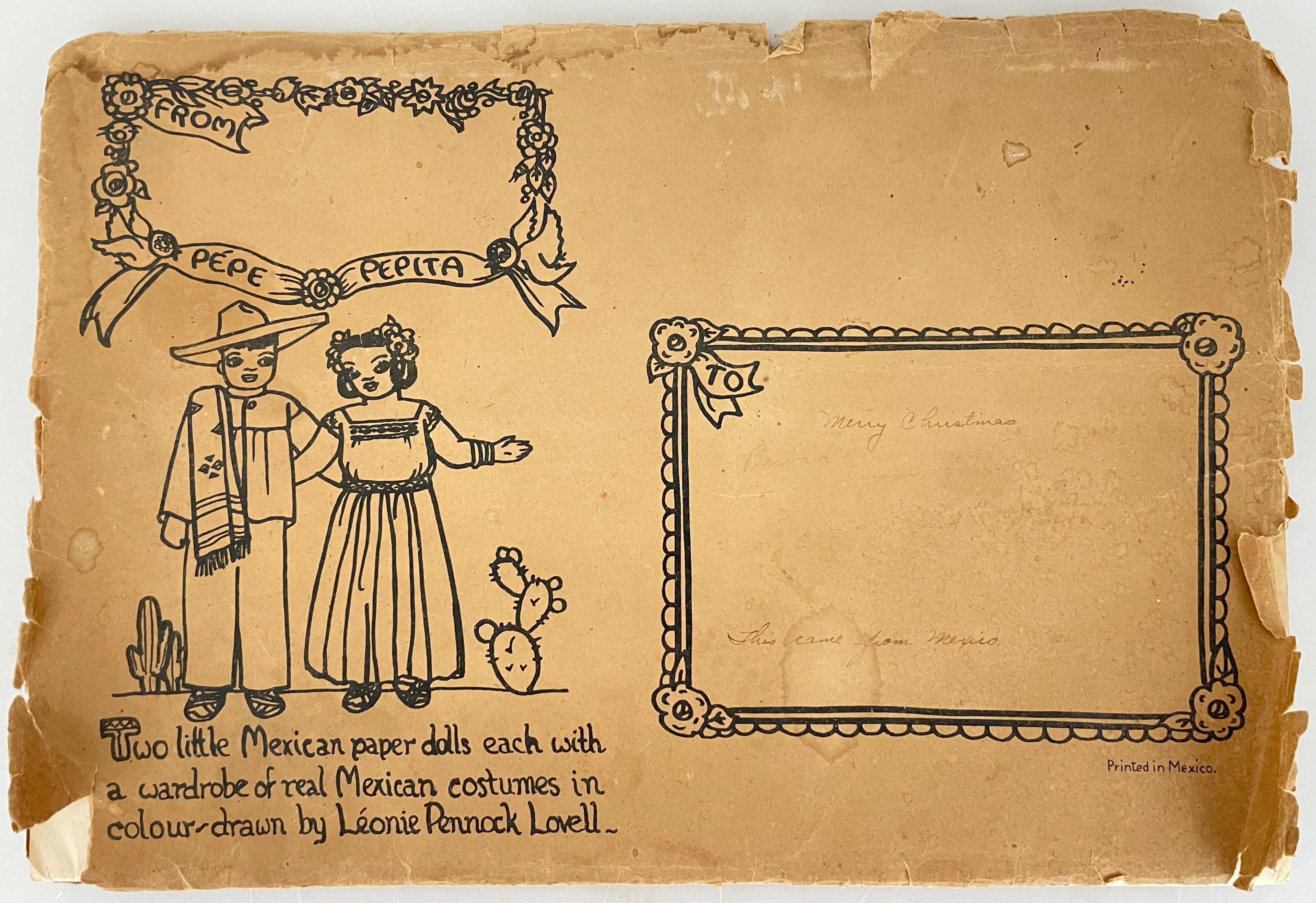
This is the envelope this wonderful set of paper dolls arrived in.  I did not find information when this set was produced, but I am guessing it was in the 1930-40s era. The artist is Leonie Pennock Lovell, lifespan 1916-2006. The envelope indicates if was printed in Mexico. 

Pepe and Pepita are 10" paper dolls printed on heavy weight paper. 


Saturday, May 3, 2025

Do you know dapper Mr. Mouse....or is he Mr. Rat?

This is Mr. Mouse....or maybe Mr. Rat.
Looking a bit spiffy here even though 
he has patches on his knickers.
He is a paper doll standing 8 inches tall that
was published in The New York Tribune in 1931.


When he wants to dress for fun, you will find him
in his white slacks, striped blazer and sweater vest
 while sporting a flower in his lapel. 
He considers himself a real "dandy" on the town.

When he wants to impress his lady, how does he dress? 
Fancy overcoat, plaid slacks, spats, 
leather gloves, a cane for good measure 
and a box of candy under his arm!

 Say good-by and good luck to Mr. Mouse!


Saturday, March 19, 2022

Dolls of Many Lands


Dolls of many lands  is a boxed set of paper dolls
 published by Whitman Publishing Company in 1932, 
catalogued as  W3046. Ten countries are represented. Each paper doll is printed on individual heavy paper stock in lovely pastel colors and drawn in the wonderful style of the 1930s era. 


Gretel of Holland in her little wooden shoes, 
braids down her back and holding tulips....of course!


Little Flower of Japan, in her patterned kimono 
secured with an obi, is holding a Japanese lantern, 
and carrying a lovely parasol.


Jock of Scotland in his tartan kilts, 
playing a bagpipe, tapping a drum,
 or performing a Highland dance!


Marie of Italy, with a band of flowers to wear in her dark tresses, 
a tambourine to play while she dances, 
and fresh fruit picked from the orchard.


Fritz of Germany, his pet Dachshund in his arms, 
lederhosen to wear with his alpine hat, 
and a miltary uniform to be just like dad.


Colleen of Ireland, a "wearing of the green" 
in traditional dress, and a bouquet of clover tucked close. 


Olga of Russia, with lovely embroidered dresses 
and both a babushka scarf and kokoshnik to wear on her head.


Bill of the USA, our All-American boy, with uniforms for scouting
 and baseball, and a football for sandlot games.


Dolores of Spain, with a flower tucked behind her ear, 
a guitar for singing, a swinging skirt for dancing, 
and a mantilla with peineta.


 Hildur of Sweden, with colorful aprons adorning each dress 
and traditional hats/scarfs of Sweden. 

Monday, February 14, 2022

Bob and Nan Cut Out Dolls....circa 1913


Mary Young, in her publication of 20th Century Paper Dolls Identification and Values (2006), indicates that Bob and Nan Cut Out Dolls was published by M.A. Donohue & Co., but no date is given. Other paper dolls Donohue produced indicate they were published around 1913, and the clothes included in this book reflect the fashions of the 1910-1920 era. 


      Bob has four outfits, all with short pants and long sleeves shirts.


     Nan has four dresses, all with short sleeves, five hats and a doll.  


 Nan even has a large dolly with clothes and toys made especially for him!


This is a large format book of paper dolls, measuring 18" by 10". The company that produced them, M.A. Donohue & Co., was a publisher of children's books in the late 1800s and the first half of the 20th century. With offices in Chicago and New York, the company was known for inexpensive editions of popular works of fiction.